

June linkies
Recent lessons in failure
As recently mentioned, I love stories of artistic failure. I rarely miss one in my daily scrolling1, but of course I’ve noticed a bunch more since posting about my own.
I figure I can’t be the only one who reads these stories like fairy tales, so I’ve collected them here along with the lessons they offer.
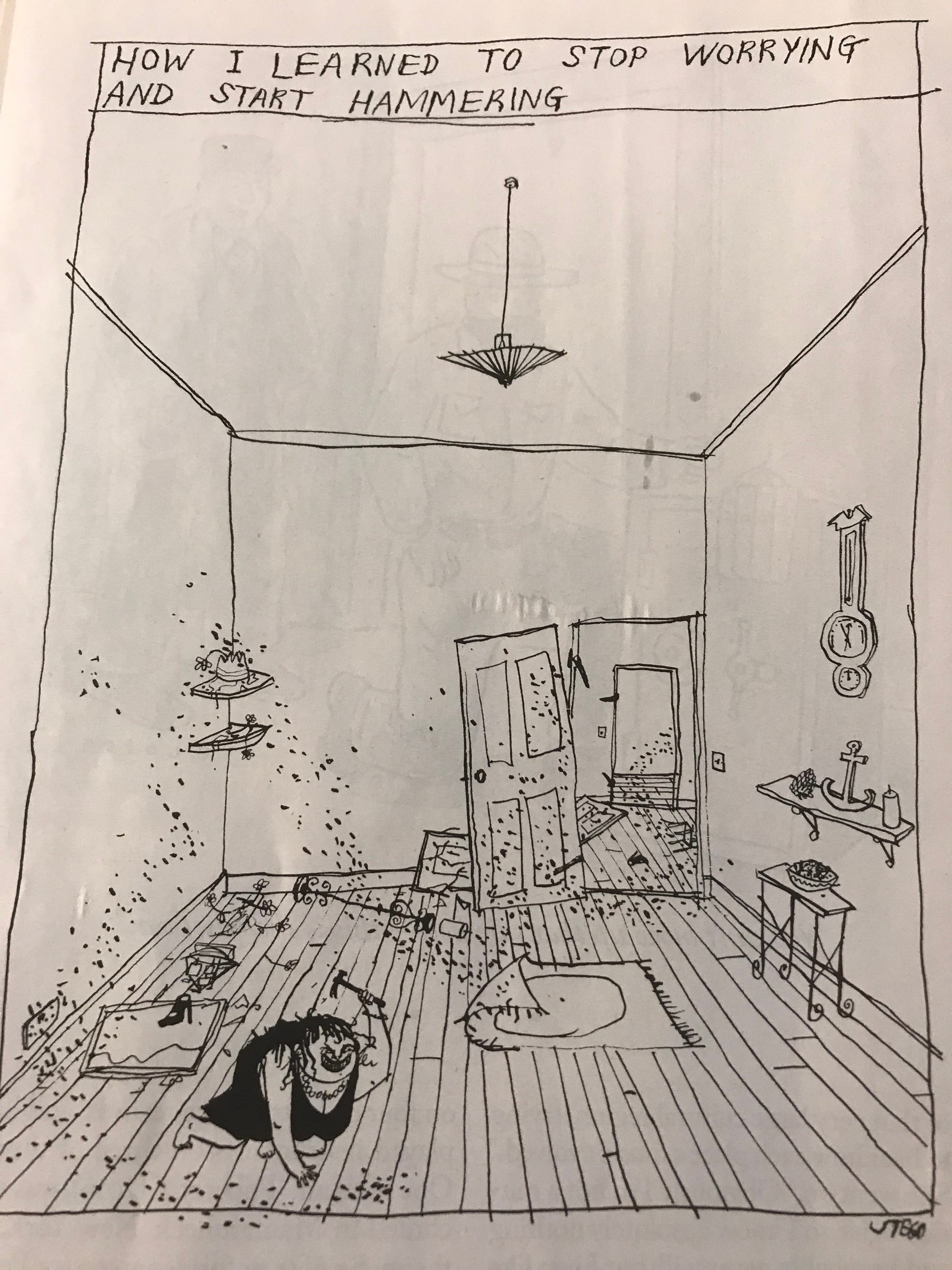
Lean into failure
Everyone knows the story of the near-disastrous production of Jaws. The animatronics kept failing so director Steven Spielberg made lemonade from lemons and used POV shots and John Williams’s iconic score to create something suggestive and actually more suspenseful.
In my book, though, no one has used failure quite like New Wave director Agnes Varda. Here are two examples I love:
Critics, audiences, and Varda herself all considered her 1966 film Les Créatures her biggest failure. Years after the fact, she built a cabin from the film’s negatives, creating an immersive art installation called Ma cabane de l'échec (My Shack of Failure)2.
In 1972 Varda had a son, which is obviously not a failure, but it is constraining. Again, she used this, filming a documentary about her street, Rue Daguerre, which was named for Louise Daguerre, one of the fathers of photography. She shot the entire film, “Daguerréotypes” (1975), within three hundred feet (the distance permitted by her equipment’s electric cable) of her home studio.
I am unfortunately not Agnes Varda (or Steven Spielberg), so I appreciate agent Anna Sproul-Latimer’s handy flying analogy: Pilots are trained to go nose down when they stall. Rather than fight gravity, they use it to gain speed they can eventually climb on. Creatives can follow their example by trying to “make the struggle itself the stuff of your art.”
I also like the simplicity of this prompt from novelist, poet, and critic Lucy Ives: take your draft that isn’t working and try “to write even more intensely in its style.”
If you don’t have a draft to work from, Tony Tulathimutte3 suggests, “pick your dumbest idea and write it as seriously as possible.”
Blow your failure up
Sometimes it’s not enough to just lean into your failure. You have to blow it up.
When Chris Pavone asked legendary publisher Sonny Mehta for feedback on his first novel, Mehta told him, “not enough happens.” Pavone realized that his editing process had been too much about cleaning things up, rather than blowing them up. He went back through the manuscript, looking for places to dial up tension, create bigger conflicts, and add unexpected twists. The resulting book became his bestseller The Expats.
Even if you write literary fiction, as opposed to suspense, you might benefit from a few “explosions.” In A Long Game, Elizabeth McCracken suggests rapidly brainstorming possible events, knowing that most will be nonsense. Some won’t—when choosing among these exceptions, prioritize interest over meaning. “It’s easier to make something interesting and strange meaningful than it is to take a feeling of abstract import and try to guess what event might illustrate that in an interesting way,” she explains.
Embrace failure as its own sort of accomplishment
You can also go the opposite direction and try to revel in your failure, as I’ve said I will. Except I’m not entirely sure how.
Pulitzer Prize winner Kelly Link offers one clue: “Passionate dislike is a form of active engagement! How nice that someone cares so much! I often think of the Amazon reviewer who said that my collection was the worst book they’d ever read. I sometimes worry that they have since read a book they dislike even more and that I have written the book that is now only their second-most hated book.”
In The Believer, novelist Andrei Bajani has another. Of the “graveyard” folder he keeps full of his unfinished writing, he says, “It’s not a graveyard but a habitat, a microclimate, the only place possible for these missing stories to survive, to live together, without having to apologize for not being able to end.”
Push past failure
This lesson’s obvious, but hard, so I’ll take all the reminders I can get. On CRAFT TALK, Pulitzer Prize and National Book Award winner Colson Whitehead shares the story of his first failed novel. He didn’t know how he’d ever write another one and became obsessed with horoscopes, reading three a day in the hopes of finding an answer. Then he read the Taoist saying “Even sand when accumulated makes a mountain” and realized the answer was bit by bit.
What if not just your first novel failed, but your second, third, and fourth too? In this old New Yorker piece Malcolm Gladwell draws on examples like Paul Cézanne and author Ben Fountain to map the lifecycle of the late bloomer: “We’d like to think that mundane matters like loyalty, steadfastness, and the willingness to keep writing checks to support what looks like failure have nothing to do with something as rarefied as genius. But sometimes genius is anything but rarefied; sometimes it’s just the thing that emerges after twenty years of working at your kitchen table.”
On that note, the latest failure story to pop up in my feeds is Gabriel García Márquez’s 1981 rejection letter from The New Yorker:
I believe this story first circulated on Twitter a few years ago. It’s not even a fairy tale, it’s a meme—one day he’s rejected by The New Yorker, the next he’s a Nobel Prize winner!
That version glosses over a whole lot. García Márquez spent 17 years on his masterpiece One Hundred Years of Solitude. Prior to its publication, he wrote scripts, ad copy, tabloid fodder, and short novels that few people read. Those years of struggle instilled in him discipline (he actually compared writing to carpentry), developed his craft, and made for a much better story.
My corner of the internet is defined by writerliness, pants that won’t make you sweat at the park, catastrophic images of crises adjacent to other crises I recently donated to, specialty bakeries in cities where I don’t live, and whatever weird shit my brother is on lately.
Considering this for my tombstone.
this was a rly great read to start the day —> especially after arguing with a human half my size for the first first part of the day.
Fantastic work thank you for writing all of this and sharing